UI / UX Design
How I helped reduce search-related CES complaints by 42%
Last updated:
2025
Industry:
Education
Client:
Estratégia
Project duration:
6 weeks

Context
Estratégia Educacional is an edtech company that sells preparatory courses for national exams and assessments. Its catalog ranges from packages with hundreds of courses focused on specific exams to subscriptions that give students access to thousands of courses across multiple fields. These courses run on a white-label platform shared by 6 business verticals, with the same core set of features.
The platform experience was built around the profile of the civil-service exam student: autonomous, used to exploring content independently and building their own study routine. As a result, the platform worked more like a large course repository than a guided study journey. Over time, new pedagogical solutions, content formats, and courses were added. The platform grew, the catalog became denser, and finding the right content became progressively more difficult for students who did not have that same level of autonomy.


Figure 1: Student repository in each platform vertical. In order: Legal Careers, Public Exams, College Entrance Exams, Military, and Medicine.
Scenario
The product team was working on initiatives based on unvalidated hypotheses, with new features being built all the time. The risk was that the team would spend energy executing solutions for problems that were not well understood.
Leadership recognized this pattern and defined a new strategic direction: instead of focusing on quantity, the focus would shift to improving the quality of the experience of what already existed on the platform. In practice, this meant a change in posture required by the CPTO. Discovery would now be directed toward existing features to reduce uncertainty, generate usability inputs for roadmap tasks, and bring more mature demands to engineering before implementation. It was in this context that search came onto the radar.
Problem
The PM wanted to solve the content findability problem by introducing new features. However, the data did not support that direction. As the person responsible for analyzing the CES, I identified that most detractor comments pointed directly to search. This also aligned with an existing internal consensus that the platform’s search experience was not working well. It was the main barrier to finding content.
Search is the student’s entry point. When students spend time trying to locate material before they can even start studying, they complain to the course coordinator, in student groups, on public complaint channels such as Reclame Aqui, and, as a consequence, may cancel the product and leave. This made search the most direct bet for impacting both experience and retention. For this reason, improving this experience became one of the quarterly objectives for the Technology and Design team in Q1 2026, with roadmap capacity reserved to address the problems identified during discovery.


Figure 2: Screenshot of CES search feedback and spreadsheet with exported comments.
Search mechanisms:
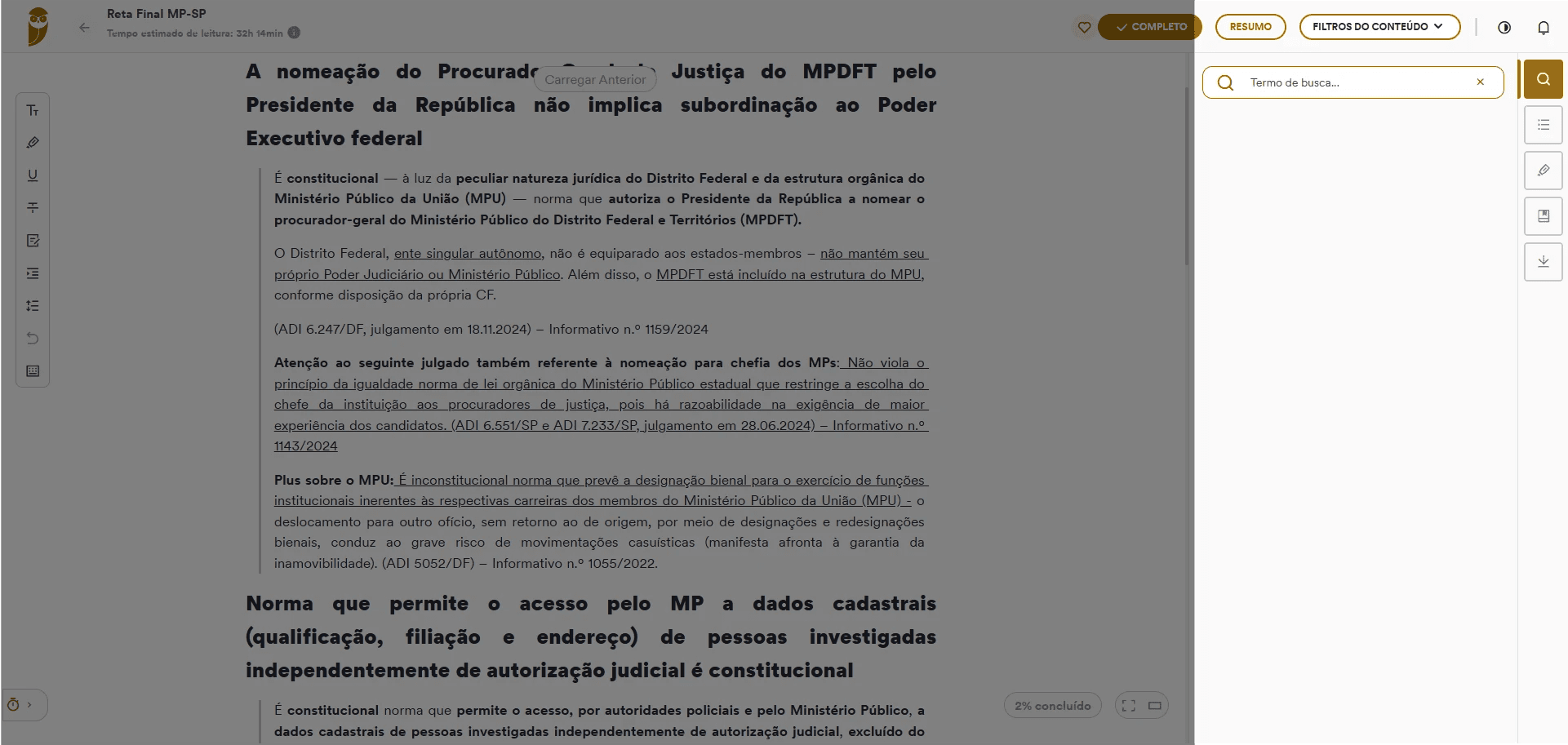
Students called everything "search," but the platform had two different mechanisms: external search, used to find courses and materials in the student's repository. It works more like a filter than a search, because the user needs to select the context of what they are looking for and it can only return results from within the selected context; and internal search, which worked like CTRL+F inside the open content, allowing students to locate specific excerpts within a material.
This distinction was important because it showed that part of the frustration was not located in a single feature, but in the student's expectation of where and how to find each type of material.

Investigation
I led a research initiative to turn internal hypotheses into a clearer and more prioritizable understanding of the problem. I started from what the team already believed: the algorithm returned noisy results; students used valid terms that search did not recognize; a synonyms dictionary was missing; and context-separated searches confused students about where to search for each type of material.
To investigate them, I combined complementary sources of evidence:
CES: I analyzed more than 3,000 comments with the support of an AI agent to identify the main symptoms reported by students and understand the frequency of the problems.
Search history: to understand how students searched in practice, which terms they used, and where search failed to respond.
Heatmaps and recordings: to identify where students navigated, where they tried to search, and where they gave up.
Product reproduction: to experience the reported failures directly in the platform, turning feedback into concrete evidence.
The process was iterative. Learnings from one method fed new analyses in another. I continued until I noticed that the same problems were consistently recurring across different sources. When there was no longer any new learning, I had enough evidence to make a recommendation.
Key findings
1. Mental model incompatible with the logic of search
For every 10 searches, 6 were performed in the wrong context. Students searched in one place expecting to find something that only existed somewhere else. Search history confirmed this behavior, and the heatmap reinforced it: the context selector was rarely used, showing that the segmentation logic of search simply was not clear to users.
Figure 3: “Administrative Law” is a subject. To find it, students needed to access the correct tab or select the appropriate search context.
2. Low precision in matching searched terms
In both external and internal search, the search interpreted compound expressions as separate terms. Specific queries returned results related only to parts of the searched term. In a platform with a large volume of similar courses, this increased the student’s cognitive effort to identify the right result.

Figure 4: When searching for “institutional theses of MPSP,” search returned results by considering only part of the term, such as “theses.”
3. Low continuity between result and destination
Even when search returned a useful result, it did not always take the student to the exact point in the content. In external search, chapter-level results took students to the material, but not to the chapter found. In internal search, clicking also did not take them directly to the correct excerpt. Search pointed to a possible answer, but still transferred to the student the work of manually finding the exact point within the material.
Figure 5: Search returned a chapter called “Strategic Summary,” but clicking it directed the student to another point in the material.
4. Coverage and depth below students’ expectations
Search history showed students using external search as if it were a global search, trying to locate terms that only existed inside the materials. Reports such as “I couldn’t find law X” or “I can’t find the material about Y” appeared frequently in CES. Valid queries that returned few or no results created the perception that the content simply did not exist on the platform.
Figure 6: External search did not return results for a specific law, but the same term was found inside the content.
Technical feasibility
With the findings consolidated, I aligned with the PM and engineering to discuss opportunities, solution paths, and technical feasibility. Some of the alternatives evaluated were:
Algorithm improvement: working on search scoring and exact matching
Improving result anchoring: taking the student directly to the correct excerpt, chapter, or item.
Global search: the student could search regardless of context. Although this was closer to the students’ mental model, it required structural changes to search and to the content classification system, demanding effort and time beyond the quarter’s scope.
Search within content: however, this carried a performance risk because it would require very broad scans, and it could also hurt search relevance by expanding the number of results.


Figure 6: Tasks prioritized in the roadmap.
Decision
When presenting the findings to the CPTO, my recommendation was to invest in algorithm improvements before expanding the scope of search. Expanding coverage before improving result quality would create the risk of increasing the volume of results without increasing relevance.
The prioritized improvements involved adjustments to result ranking, better matching between searched terms and content, and more precise anchoring within the structure of the materials.
Results

The goal was to reduce negative CES comments about search by 20%. After the launch in February 2026, the volume of comments classified as “Difficult” dropped from 331 to 191 compared to the same period of the previous year, a 42% reduction.
The post-launch qualitative analysis confirmed where the decrease was concentrated: result relevance and “I can’t find what I’m looking for,” exactly what the prioritization had addressed. The problem was never a lack of features. It was the quality of something students already used every day.
Learnings
For a moment, my initial impression was that search was an interface problem. But going deeper into the discovery made it clear that the interface was only where the problem surfaced. The root cause was in how search had been built and how it operated within the student experience. This prevented us from falling into the trap of trying to solve the student’s problem by simply proposing a new feature.
Problem
Internally, there was consensus that the platform search did not work well. The PM wanted to solve this with new features. As the person responsible for CES analysis, I showed that the data did not support that direction: most detractor comments pointed directly to search. It was the main obstacle to finding content.
Search is the student’s entry point. When students spend time trying to locate material before they can even start studying, they complain to the course coordinator, in student groups, on public complaint channels such as Reclame Aqui, and, as a consequence, may cancel the product and leave. This made search the most direct bet for impacting both experience and retention. For this reason, improving this experience became one of the quarterly objectives for the Technology and Design team in Q1 2026, with roadmap capacity reserved to address the problems identified during discovery.
Figure 2: Screenshot of CES search feedback and spreadsheet with exported comments.
Search mechanisms:
Students called everything "search," but the platform had two different mechanisms: external search, used to find courses and materials in the student's repository. It works more like a filter than a search, because the user needs to select the context of what they are looking for and it can only return results from within the selected context; and internal search, which worked like CTRL+F inside the open content, allowing students to locate specific excerpts within a material.
This distinction was important because it showed that part of the frustration was not located in a single feature, but in the student's expectation of where and how to find each type of material.
Key findings
1. Mental model incompatible with the logic of search
For every 10 searches, 6 were performed in the wrong context. Students searched in one place expecting to find something that only existed somewhere else. Search history confirmed this behavior, and the heatmap reinforced it: the context selector was rarely used, showing that the segmentation logic of search simply was not clear to users.
Figure 3: “Administrative Law” is a subject. To find it, students needed to access the correct tab or select the appropriate search context.
2. Low precision in matching searched terms
In both external and internal search, the search interpreted compound expressions as separate terms. Specific queries returned results related only to parts of the searched term. In a platform with a large volume of similar courses, this increased the student’s cognitive effort to identify the right result.
Figure 4: When searching for “institutional theses of MPSP,” search returned results by considering only part of the term, such as “theses.”
3. Low continuity between result and destination
Even when search returned a useful result, it did not always take the student to the exact point in the content. In external search, chapter-level results took students to the material, but not to the chapter found. In internal search, clicking also did not take them directly to the correct excerpt. Search pointed to a possible answer, but still transferred to the student the work of manually finding the exact point within the material.
Figure 5: Search returned a chapter called “Strategic Summary,” but clicking it directed the student to another point in the material.
4. Coverage and depth below students’ expectations
Search history showed students using external search as if it were a global search, trying to locate terms that only existed inside the materials. Reports such as “I couldn’t find law X” or “I can’t find the material about Y” appeared frequently in CES. Valid queries that returned few or no results created the perception that the content simply did not exist on the platform.
Figure 6: External search did not return results for a specific law, but the same term was found inside the content.

UI / UX Design
How I helped reduce search-related CES complaints by 42%
Last updated:
2025
Industry:
Education
Client:
Estratégia
Project duration:
6 weeks
Context
Estratégia Educacional is an edtech company that sells preparatory courses for national exams and assessments. Its catalog ranges from packages with hundreds of courses focused on specific exams to subscriptions that give students access to thousands of courses across multiple fields. These courses run on a white-label platform shared by 6 business verticals, with the same core set of features.
The platform experience was built around the profile of the civil-service exam student: autonomous, used to exploring content independently and building their own study routine. As a result, the platform worked more like a large course repository than a guided study journey. Over time, new pedagogical solutions, content formats, and courses were added. The platform grew, the catalog became denser, and finding the right content became progressively more difficult for students who did not have that same level of autonomy.
Figure 1: Student repository in each platform vertical. In order: Legal Careers, Public Exams, College Entrance Exams, Military, and Medicine.
Scenario
The product team was working on initiatives based on unvalidated hypotheses, with new features being built all the time. The risk was that the team would spend energy executing solutions for problems that were not well understood.
Leadership recognized this pattern and defined a new strategic direction: instead of focusing on quantity, the focus would shift to improving the quality of the experience of what already existed on the platform. In practice, this meant a change in posture required by the CPTO. Discovery would now be directed toward existing features to reduce uncertainty, generate usability inputs for roadmap tasks, and bring more mature demands to engineering before implementation. It was in this context that search came onto the radar.
Problem
The PM wanted to solve the content findability problem by introducing new features. However, the data did not support that direction. As the person responsible for analyzing the CES, I identified that most detractor comments pointed directly to search. This also aligned with an existing internal consensus that the platform’s search experience was not working well. It was the main barrier to finding content.
Search is the student’s entry point. When students spend time trying to locate material before they can even start studying, they complain to the course coordinator, in student groups, on public complaint channels such as Reclame Aqui, and, as a consequence, may cancel the product and leave. This made search the most direct bet for impacting both experience and retention. For this reason, improving this experience became one of the quarterly objectives for the Technology and Design team in Q1 2026, with roadmap capacity reserved to address the problems identified during discovery.
Figure 2: Screenshot of CES search feedback and spreadsheet with exported comments.
Search mechanisms:
Students called everything "search," but the platform had two different mechanisms: external search, used to find courses and materials in the student's repository. It works more like a filter than a search, because the user needs to select the context of what they are looking for and it can only return results from within the selected context; and internal search, which worked like CTRL+F inside the open content, allowing students to locate specific excerpts within a material.
This distinction was important because it showed that part of the frustration was not located in a single feature, but in the student's expectation of where and how to find each type of material.
Investigation
I led a research initiative to turn internal hypotheses into a clearer and more prioritizable understanding of the problem. I started from what the team already believed: the algorithm returned noisy results; students used valid terms that search did not recognize; a synonyms dictionary was missing; and context-separated searches confused students about where to search for each type of material.
To investigate them, I combined complementary sources of evidence:
CES: I analyzed more than 3,000 comments with the support of an AI agent to identify the main symptoms reported by students and understand the frequency of the problems.
Search history: to understand how students searched in practice, which terms they used, and where search failed to respond.
Heatmaps and recordings: to identify where students navigated, where they tried to search, and where they gave up.
Product reproduction: to experience the reported failures directly in the platform, turning feedback into concrete evidence.
The process was iterative. Learnings from one method fed new analyses in another. I continued until I noticed that the same problems were consistently recurring across different sources. When there was no longer any new learning, I had enough evidence to make a recommendation.
Key findings
1. Mental model incompatible with the logic of search
For every 10 searches, 6 were performed in the wrong context. Students searched in one place expecting to find something that only existed somewhere else. Search history confirmed this behavior, and the heatmap reinforced it: the context selector was rarely used, showing that the segmentation logic of search simply was not clear to users.
Figure 3: “Administrative Law” is a subject. To find it, students needed to access the correct tab or select the appropriate search context.
2. Low precision in matching searched terms
In both external and internal search, the search interpreted compound expressions as separate terms. Specific queries returned results related only to parts of the searched term. In a platform with a large volume of similar courses, this increased the student’s cognitive effort to identify the right result.
Figure 4: When searching for “institutional theses of MPSP,” search returned results by considering only part of the term, such as “theses.”
3. Low continuity between result and destination
Even when search returned a useful result, it did not always take the student to the exact point in the content. In external search, chapter-level results took students to the material, but not to the chapter found. In internal search, clicking also did not take them directly to the correct excerpt. Search pointed to a possible answer, but still transferred to the student the work of manually finding the exact point within the material.
Figure 5: Search returned a chapter called “Strategic Summary,” but clicking it directed the student to another point in the material.
4. Coverage and depth below students’ expectations
Search history showed students using external search as if it were a global search, trying to locate terms that only existed inside the materials. Reports such as “I couldn’t find law X” or “I can’t find the material about Y” appeared frequently in CES. Valid queries that returned few or no results created the perception that the content simply did not exist on the platform.
Figure 6: External search did not return results for a specific law, but the same term was found inside the content.
Technical feasibility
With the findings consolidated, I aligned with the PM and engineering to discuss opportunities, solution paths, and technical feasibility. Some of the alternatives evaluated were:
Algorithm improvement: working on search scoring and exact matching
Improving result anchoring: taking the student directly to the correct excerpt, chapter, or item.
Global search: the student could search regardless of context. Although this was closer to the students’ mental model, it required structural changes to search and to the content classification system, demanding effort and time beyond the quarter’s scope.
Search within content: however, this carried a performance risk because it would require very broad scans, and it could also hurt search relevance by expanding the number of results.
Figure 6: Tasks prioritized in the roadmap.
Decision
When presenting the findings to the CPTO, my recommendation was to invest in algorithm improvements before expanding the scope of search. Expanding coverage before improving result quality would create the risk of increasing the volume of results without increasing relevance.
The prioritized improvements involved adjustments to result ranking, better matching between searched terms and content, and more precise anchoring within the structure of the materials.
Results
The goal was to reduce negative CES comments about search by 20%. After the launch in February 2026, the volume of comments classified as “Difficult” dropped from 331 to 191 compared to the same period of the previous year, a 42% reduction.
The post-launch qualitative analysis confirmed where the decrease was concentrated: result relevance and “I can’t find what I’m looking for,” exactly what the prioritization had addressed. The problem was never a lack of features. It was the quality of something students already used every day.
Learnings
For a moment, my initial impression was that search was an interface problem. But going deeper into the discovery made it clear that the interface was only where the problem surfaced. The root cause was in how search had been built and how it operated within the student experience. This prevented us from falling into the trap of trying to solve the student’s problem by simply proposing a new feature.
Problem
Internally, there was consensus that the platform search did not work well. The PM wanted to solve this with new features. As the person responsible for CES analysis, I showed that the data did not support that direction: most detractor comments pointed directly to search. It was the main obstacle to finding content.
Search is the student’s entry point. When students spend time trying to locate material before they can even start studying, they complain to the course coordinator, in student groups, on public complaint channels such as Reclame Aqui, and, as a consequence, may cancel the product and leave. This made search the most direct bet for impacting both experience and retention. For this reason, improving this experience became one of the quarterly objectives for the Technology and Design team in Q1 2026, with roadmap capacity reserved to address the problems identified during discovery.
Figure 2: Screenshot of CES search feedback and spreadsheet with exported comments.
Search mechanisms:
Students called everything "search," but the platform had two different mechanisms: external search, used to find courses and materials in the student's repository. It works more like a filter than a search, because the user needs to select the context of what they are looking for and it can only return results from within the selected context; and internal search, which worked like CTRL+F inside the open content, allowing students to locate specific excerpts within a material.
This distinction was important because it showed that part of the frustration was not located in a single feature, but in the student's expectation of where and how to find each type of material.
Key findings
1. Mental model incompatible with the logic of search
For every 10 searches, 6 were performed in the wrong context. Students searched in one place expecting to find something that only existed somewhere else. Search history confirmed this behavior, and the heatmap reinforced it: the context selector was rarely used, showing that the segmentation logic of search simply was not clear to users.
Figure 3: “Administrative Law” is a subject. To find it, students needed to access the correct tab or select the appropriate search context.
2. Low precision in matching searched terms
In both external and internal search, the search interpreted compound expressions as separate terms. Specific queries returned results related only to parts of the searched term. In a platform with a large volume of similar courses, this increased the student’s cognitive effort to identify the right result.
Figure 4: When searching for “institutional theses of MPSP,” search returned results by considering only part of the term, such as “theses.”
3. Low continuity between result and destination
Even when search returned a useful result, it did not always take the student to the exact point in the content. In external search, chapter-level results took students to the material, but not to the chapter found. In internal search, clicking also did not take them directly to the correct excerpt. Search pointed to a possible answer, but still transferred to the student the work of manually finding the exact point within the material.
Figure 5: Search returned a chapter called “Strategic Summary,” but clicking it directed the student to another point in the material.
4. Coverage and depth below students’ expectations
Search history showed students using external search as if it were a global search, trying to locate terms that only existed inside the materials. Reports such as “I couldn’t find law X” or “I can’t find the material about Y” appeared frequently in CES. Valid queries that returned few or no results created the perception that the content simply did not exist on the platform.
Figure 6: External search did not return results for a specific law, but the same term was found inside the content.
UI / UX Design
How I helped reduce search-related CES complaints by 42%
Last updated:
2025
Industry:
Education
Client:
Estratégia
Project duration:
6 weeks
Context
Estratégia Educacional is an edtech company that sells preparatory courses for national exams and assessments. Its catalog ranges from packages with hundreds of courses focused on specific exams to subscriptions that give students access to thousands of courses across multiple fields. These courses run on a white-label platform shared by 6 business verticals, with the same core set of features.
The platform experience was built around the profile of the civil-service exam student: autonomous, used to exploring content independently and building their own study routine. As a result, the platform worked more like a large course repository than a guided study journey. Over time, new pedagogical solutions, content formats, and courses were added. The platform grew, the catalog became denser, and finding the right content became progressively more difficult for students who did not have that same level of autonomy.
Figure 1: Student repository in each platform vertical. In order: Legal Careers, Public Exams, College Entrance Exams, Military, and Medicine.
Scenario
The product team was working on initiatives based on unvalidated hypotheses, with new features being built all the time. The risk was that the team would spend energy executing solutions for problems that were not well understood.
Leadership recognized this pattern and defined a new strategic direction: instead of focusing on quantity, the focus would shift to improving the quality of the experience of what already existed on the platform. In practice, this meant a change in posture required by the CPTO. Discovery would now be directed toward existing features to reduce uncertainty, generate usability inputs for roadmap tasks, and bring more mature demands to engineering before implementation. It was in this context that search came onto the radar.
Problem
The PM wanted to solve the content findability problem by introducing new features. However, the data did not support that direction. As the person responsible for analyzing the CES, I identified that most detractor comments pointed directly to search. This also aligned with an existing internal consensus that the platform’s search experience was not working well. It was the main barrier to finding content.
Search is the student’s entry point. When students spend time trying to locate material before they can even start studying, they complain to the course coordinator, in student groups, on public complaint channels such as Reclame Aqui, and, as a consequence, may cancel the product and leave. This made search the most direct bet for impacting both experience and retention. For this reason, improving this experience became one of the quarterly objectives for the Technology and Design team in Q1 2026, with roadmap capacity reserved to address the problems identified during discovery.
Figure 2: Screenshot of CES search feedback and spreadsheet with exported comments.
Search mechanisms:
Students called everything "search," but the platform had two different mechanisms: external search, used to find courses and materials in the student's repository. It works more like a filter than a search, because the user needs to select the context of what they are looking for and it can only return results from within the selected context; and internal search, which worked like CTRL+F inside the open content, allowing students to locate specific excerpts within a material.
This distinction was important because it showed that part of the frustration was not located in a single feature, but in the student's expectation of where and how to find each type of material.
Investigation
I led a research initiative to turn internal hypotheses into a clearer and more prioritizable understanding of the problem. I started from what the team already believed: the algorithm returned noisy results; students used valid terms that search did not recognize; a synonyms dictionary was missing; and context-separated searches confused students about where to search for each type of material.
To investigate them, I combined complementary sources of evidence:
CES: I analyzed more than 3,000 comments with the support of an AI agent to identify the main symptoms reported by students and understand the frequency of the problems.
Search history: to understand how students searched in practice, which terms they used, and where search failed to respond.
Heatmaps and recordings: to identify where students navigated, where they tried to search, and where they gave up.
Product reproduction: to experience the reported failures directly in the platform, turning feedback into concrete evidence.
The process was iterative. Learnings from one method fed new analyses in another. I continued until I noticed that the same problems were consistently recurring across different sources. When there was no longer any new learning, I had enough evidence to make a recommendation.
Key findings
1. Mental model incompatible with the logic of search
For every 10 searches, 6 were performed in the wrong context. Students searched in one place expecting to find something that only existed somewhere else. Search history confirmed this behavior, and the heatmap reinforced it: the context selector was rarely used, showing that the segmentation logic of search simply was not clear to users.
Figure 3: “Administrative Law” is a subject. To find it, students needed to access the correct tab or select the appropriate search context.
2. Low precision in matching searched terms
In both external and internal search, the search interpreted compound expressions as separate terms. Specific queries returned results related only to parts of the searched term. In a platform with a large volume of similar courses, this increased the student’s cognitive effort to identify the right result.
Figure 4: When searching for “institutional theses of MPSP,” search returned results by considering only part of the term, such as “theses.”
3. Low continuity between result and destination
Even when search returned a useful result, it did not always take the student to the exact point in the content. In external search, chapter-level results took students to the material, but not to the chapter found. In internal search, clicking also did not take them directly to the correct excerpt. Search pointed to a possible answer, but still transferred to the student the work of manually finding the exact point within the material.
Figure 5: Search returned a chapter called “Strategic Summary,” but clicking it directed the student to another point in the material.
4. Coverage and depth below students’ expectations
Search history showed students using external search as if it were a global search, trying to locate terms that only existed inside the materials. Reports such as “I couldn’t find law X” or “I can’t find the material about Y” appeared frequently in CES. Valid queries that returned few or no results created the perception that the content simply did not exist on the platform.
Figure 6: External search did not return results for a specific law, but the same term was found inside the content.
Technical feasibility
With the findings consolidated, I aligned with the PM and engineering to discuss opportunities, solution paths, and technical feasibility. Some of the alternatives evaluated were:
Algorithm improvement: working on search scoring and exact matching
Improving result anchoring: taking the student directly to the correct excerpt, chapter, or item.
Global search: the student could search regardless of context. Although this was closer to the students’ mental model, it required structural changes to search and to the content classification system, demanding effort and time beyond the quarter’s scope.
Search within content: however, this carried a performance risk because it would require very broad scans, and it could also hurt search relevance by expanding the number of results.
Figure 6: Tasks prioritized in the roadmap.
Decision
When presenting the findings to the CPTO, my recommendation was to invest in algorithm improvements before expanding the scope of search. Expanding coverage before improving result quality would create the risk of increasing the volume of results without increasing relevance.
The prioritized improvements involved adjustments to result ranking, better matching between searched terms and content, and more precise anchoring within the structure of the materials.
Results
The goal was to reduce negative CES comments about search by 20%. After the launch in February 2026, the volume of comments classified as “Difficult” dropped from 331 to 191 compared to the same period of the previous year, a 42% reduction.
The post-launch qualitative analysis confirmed where the decrease was concentrated: result relevance and “I can’t find what I’m looking for,” exactly what the prioritization had addressed. The problem was never a lack of features. It was the quality of something students already used every day.
Learnings
For a moment, my initial impression was that search was an interface problem. But going deeper into the discovery made it clear that the interface was only where the problem surfaced. The root cause was in how search had been built and how it operated within the student experience. This prevented us from falling into the trap of trying to solve the student’s problem by simply proposing a new feature.
Problem
Internally, there was consensus that the platform search did not work well. The PM wanted to solve this with new features. As the person responsible for CES analysis, I showed that the data did not support that direction: most detractor comments pointed directly to search. It was the main obstacle to finding content.
Search is the student’s entry point. When students spend time trying to locate material before they can even start studying, they complain to the course coordinator, in student groups, on public complaint channels such as Reclame Aqui, and, as a consequence, may cancel the product and leave. This made search the most direct bet for impacting both experience and retention. For this reason, improving this experience became one of the quarterly objectives for the Technology and Design team in Q1 2026, with roadmap capacity reserved to address the problems identified during discovery.
Figure 2: Screenshot of CES search feedback and spreadsheet with exported comments.
Search mechanisms:
Students called everything "search," but the platform had two different mechanisms: external search, used to find courses and materials in the student's repository. It works more like a filter than a search, because the user needs to select the context of what they are looking for and it can only return results from within the selected context; and internal search, which worked like CTRL+F inside the open content, allowing students to locate specific excerpts within a material.
This distinction was important because it showed that part of the frustration was not located in a single feature, but in the student's expectation of where and how to find each type of material.
Key findings
1. Mental model incompatible with the logic of search
For every 10 searches, 6 were performed in the wrong context. Students searched in one place expecting to find something that only existed somewhere else. Search history confirmed this behavior, and the heatmap reinforced it: the context selector was rarely used, showing that the segmentation logic of search simply was not clear to users.
Figure 3: “Administrative Law” is a subject. To find it, students needed to access the correct tab or select the appropriate search context.
2. Low precision in matching searched terms
In both external and internal search, the search interpreted compound expressions as separate terms. Specific queries returned results related only to parts of the searched term. In a platform with a large volume of similar courses, this increased the student’s cognitive effort to identify the right result.
Figure 4: When searching for “institutional theses of MPSP,” search returned results by considering only part of the term, such as “theses.”
3. Low continuity between result and destination
Even when search returned a useful result, it did not always take the student to the exact point in the content. In external search, chapter-level results took students to the material, but not to the chapter found. In internal search, clicking also did not take them directly to the correct excerpt. Search pointed to a possible answer, but still transferred to the student the work of manually finding the exact point within the material.
Figure 5: Search returned a chapter called “Strategic Summary,” but clicking it directed the student to another point in the material.
4. Coverage and depth below students’ expectations
Search history showed students using external search as if it were a global search, trying to locate terms that only existed inside the materials. Reports such as “I couldn’t find law X” or “I can’t find the material about Y” appeared frequently in CES. Valid queries that returned few or no results created the perception that the content simply did not exist on the platform.
Figure 6: External search did not return results for a specific law, but the same term was found inside the content.